Short-drama script
A complete script with hook, conflict, reversals, payoff, platform pacing, and usable production notes.
OKX.AI A2A result merchant
Submit a creative brief. Receive a ready-to-deliver AI short drama package: script, character logic, scene design, storyboard, first-frame stills, generated clips, and final production assets.
Knowledge
Short-drama, TV, and film pattern layer
Direction
Unified ShotIntent for every shot
Delivery
15s, 30s, and 60s result packages
Production order
Brief to finished package
Brief
Buyer submits a story idea, audience, style, platform, and result package.
Direction
Agent selects genre patterns, hook strategy, conflict rhythm, and shot grammar.
Production
Script, character bible, scene design, storyboard, stills, and video prompts are prepared.
Delivery
The buyer receives a finished short-drama package, not a control panel.
Text in
Story, idea, or rough demand
Director object
Script, scene, shot, and continuity
Render-ready
Two internal prompt profiles
Result out
Final short-drama delivery package
Reference scale
The first knowledge layer starts from curated high-signal short-drama samples, then expands each source into hook, plot, shot language, edit rhythm, character pressure, scene purpose, and generation constraints. The homepage shows the expanded pattern-weight total buyers expect, while the database stores only abstract craft patterns.
300+
reference-weight signals shown to buyers
300
curated samples multiplied into craft dimensions
14+
reusable director-pattern families
0 copied scenes
no source dialogue, full scripts, or title cloning
Result sketch
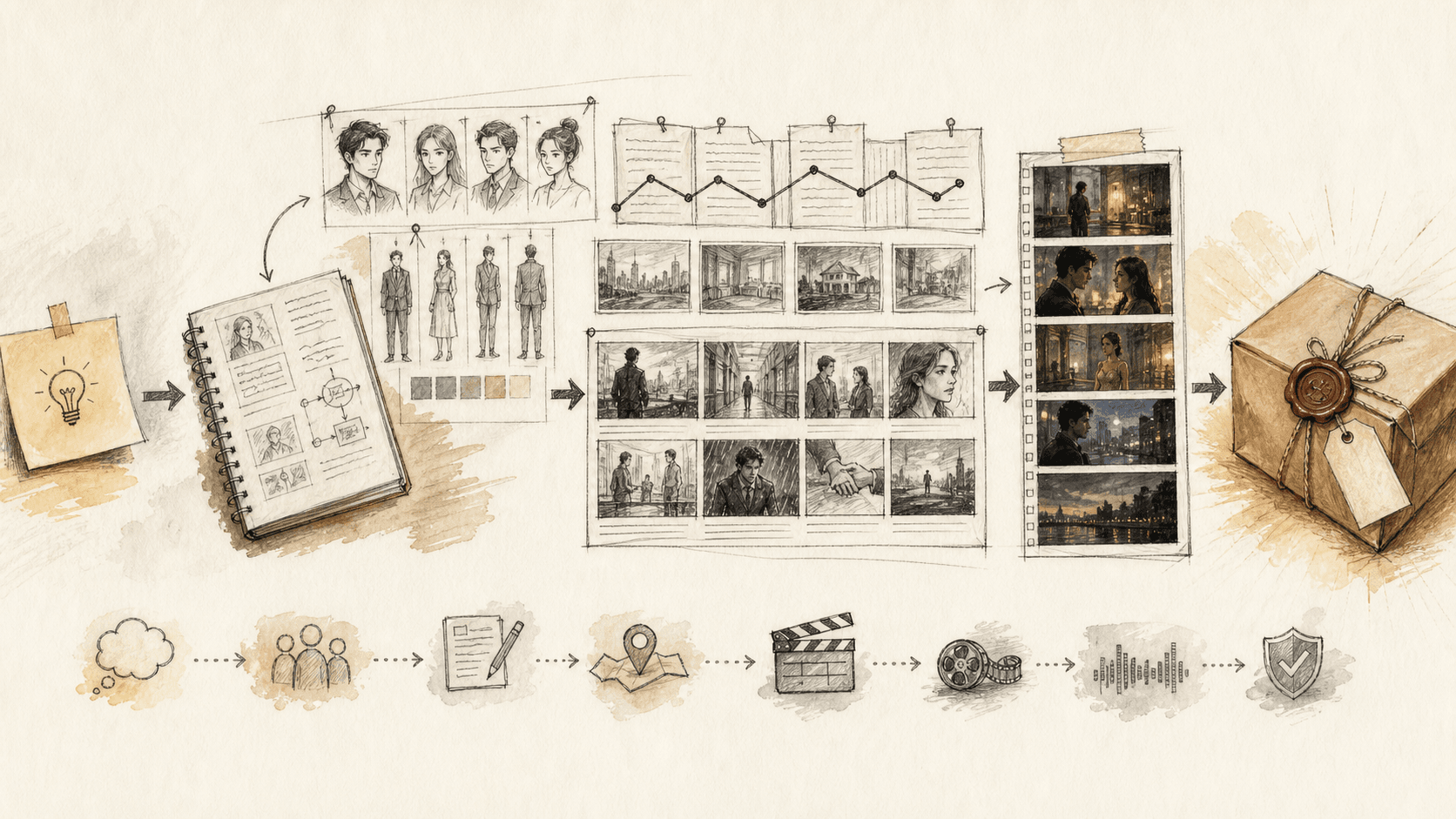
This is not an interface the buyer operates. It is the internal path Wizard runs automatically: read the idea, build the story bible, map episodes, plan shots, generate clips, and package the final drama.
Complete result
Wizard is positioned as a result agent. The buyer should not have to operate a SaaS workflow. The system builds the internal production object and returns a finished package.
A complete script with hook, conflict, reversals, payoff, platform pacing, and usable production notes.
Identity, motivation, speaking style, wardrobe, relationship pressure, visual anchors, and continuity rules.
Location intent, emotional function, props, lighting, blocking, and environment rules for generation.
Shot-by-shot structure with scene purpose, screen direction, camera angle, movement, and transition logic.
Production still prompts and references that lock identity, location, wardrobe, and the opening frame.
Internal prompt profiles compiled from the same director-level shot intent.
Knowledge engine
The homepage now explains the same layers a professional short-drama creator expects: pull analysis, inspiration planning, script craft, character design, and evaluation. Wizard adapts those layers into a result-service pipeline.
Pull analysis
The knowledge layer stores abstract patterns: genre, hook, pressure setup, reversal timing, shot rhythm, composition, and audience trigger. It does not store copied scenes, full scripts, or source dialogue.
Planning
A buyer can send a rough story, a concept, or only a desired mood. Wizard expands it into a short-drama premise with audience, stakes, relationship pressure, and a platform-ready ending.
Evaluation
Before rendering, the agent evaluates whether each scene has a purpose, whether the hook is visible, whether character behavior is consistent, and whether the final beat is clear.
Script craft
The output is not just dialogue. It includes blocking, emotional change, camera motivation, visual reveals, sound cues, and constraints that generation systems can understand.
Workflow
Every order advances from story intent to renderable shots. The key internal layer is ShotIntent: a single director-level truth that avoids prompt drift between render paths.
01
Collect story idea, target viewer, language, platform, package length, tone, visual style, and restrictions.
02
Match the brief to abstract short-drama, TV, and film patterns without copying titles, scenes, or dialogue.
03
Generate a complete short-drama script plus character identity, motivation, voice, wardrobe, and relationship map.
04
Break the script into production scenes and shots with camera angle, movement, screen direction, and scene goal.
05
Create one canonical director-level object per shot so candidate prompts do not drift from each other.
06
Generate stills and clips, check identity and continuity, retry weak shots, then assemble the delivery package.
Render language
Wizard does not create two separate stories. Each shot first becomes a unified director object with subject, action, camera, sound, continuity, first frame, and forbidden items. Compilers then prepare internal candidates for the final render strategy.
English-first cinematic language focused on subject, action, context, camera angle, camera movement, lens style, lighting, ambience, first frame, last frame, and audio.
Subject + action + scene context + camera movement + lighting + audio + continuity constraints.
Chinese-first timeline language with 0-5s and 5-10s beats, clear push, pull, pan, track, orbit, expression change, physical interaction, and sound design.
0-5s camera action, 5-10s emotional turn, physical motion, sound cue, and reference constraints.
Series continuity
For a 100-episode, one-minute series, the hard problem is not only writing the next plot beat. The agent must preserve identity, relationship state, wardrobe, locations, props, and visual grammar across episodes.
Character face, age, wardrobe, hairstyle, and signature objects stay attached to the character bible.
Episode state tracks wounds, props, relationship status, location damage, and unresolved conflicts.
Shot prompts inherit golden references and negative constraints before the final render path is selected.
Regeneration is scoped to the weak shot so a long series does not lose its core identity.
Delivery packages
Each package is framed around the finished result: duration, shot range, first-frame assets, continuity QA, and delivery depth. Buyers see the package price and deliverables only.
Basic
15s concept short
Best for fast concept validation and social hooks.
Pro
30s platform-ready short
Balanced package for paid social and creator campaigns.
Studio
60s finished delivery pack
For richer story arcs, continuity QA, and a reusable asset pack.
QA and guardrails
No copied source dialogue, titles, or source-scene recreation.
Every shot has subject, action, scene context, camera intent, sound, continuity, and forbidden items.
Buyer-facing delivery stays simple while operator pages can inspect internal prompt candidates.
If a new prompt is missing, generation falls back to the older video prompt path for existing projects.
FAQ
The public promise stays simple: submit a creative demand and receive a ready-to-deliver short drama. The production intelligence stays inside the agent.
Can the user send only a rough idea?
Yes. The brief is expanded into premise, audience promise, script, character bible, scene design, storyboard, stills, and video language.
Does Wizard expose multiple prompt profiles to the buyer?
No. Prompt profiles are internal candidates. The order renders with one selected path or a system strategy.
Can this support a 100-episode short-drama series?
Yes, the series plan needs a persistent character bible, golden references, episode state, and continuity QA per episode.
Wizard Short Drama Agent